
.jpg)


Digital Displays & LED Technology
What are digital advertising displays and LED systems?
Digital advertising displays and LED systems are electronic display solutions for presenting dynamic advertising, information and brand content indoors and outdoors. They replace static advertising media with digitally controlled, network-enabled systems using central content management. Depending on their design, brightness and protection rating, they are suitable for permanent installations or mobile use in professional B2B environments.
Typical applications include retail stores, shopping centres, sports venues, trade fairs, company reception areas, event spaces and public facilities. Content can be scheduled, managed across multiple locations and tailored to specific audiences in real time.
Types of advertising system at a glance
Digital signage
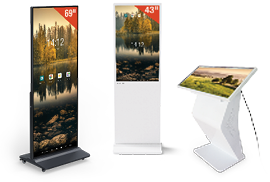
Digital advertising displays are freestanding displays that can be positioned flexibly in entrance areas, shop windows or sales spaces. They replace conventional poster stands with digital content presentation.
Most professional models use LED technology, providing high brightness and good visibility even in daylight. Some versions also use LCD technology.
Digital advertising displays are particularly suitable for changing daily offers, short-notice promotions, visitor guidance, trade fairs and events.
Depending on their design and IP protection rating, digital advertising displays can be suitable for continuous outdoor use. Mobile transport solutions such as castors or transport boxes allow the location to be changed flexibly.
LED video walls
An LED video wall consists of multiple modular LED panels combined to create a large, seamless display. Its size can be adapted individually to the room or available area. LED video walls provide high luminous intensity, scalability and modular expandability.
They are suitable for spacious sales areas, façades, events, trade fairs and sporting events where content must remain visible from a considerable distance. Indoor and outdoor versions are available depending on the design.
Stadium LED displays
LED perimeter boards are linear digital advertising systems for stadiums, arenas and event areas. They replace static stadium boards with animated, scheduled content.
Compared with conventional advertising boards, LED perimeter systems allow sponsor content to change, defined display intervals to be scheduled and multiple advertising partners to be integrated into a single event.
Mobile LED screen trailers
LED trailers are mobile large-format display systems in which LED modules are mounted on a car trailer. They enable flexible outdoor use without a permanent installation.
Typical applications include open-air events, promotional campaigns, car parks and temporary event spaces. High brightness keeps the content clearly visible even in direct sunlight.
LED display cubes and LED sphere displays
LED cubes and balls are shaped LED displays designed to create attention-grabbing indoor presentations.
LED cubes can show content on several sides simultaneously, while an LED ball provides a 360° display visible from every direction. These systems are frequently used at trade fairs, in showrooms and across retail spaces.
Which digital advertising system is suitable for each application?
- For entrance areas and changing daily offers: Digital advertising displays
- For large-format brand presentation: LED video walls
- For sponsor integration in stadiums: LED perimeter boards
- For mobile outdoor advertising: LED trailers
- For creative presentations: LED cubes or LED balls
What should you consider when buying digital advertising displays for customer communication?
The decisive selection criteria for digital advertising systems are set out below:
Installation location (indoor or outdoor)
Outdoor systems require high brightness and a suitable protection rating such as IP55 or higher.
Brightness (nits)
Outdoor use generally requires at least 3,000 nits, and often 4,000 to 5,000 nits or more in direct sunlight. Indoor applications normally require lower values between 800 and 1,500 nits.
Pixel pitch and viewing distance
Pixel pitch is the distance between two LED pixels in millimetres. The shorter the viewing distance, the smaller the pixel pitch should be.
Display-area size
Modular LED video walls are suitable for large-format installations, while individual displays are more appropriate for localised information points.
Installation and service access
Wall mounting, freestanding structures and integration into trusses all affect planning and maintenance. Front or rear access makes servicing easier.
Benefits of digital advertising media in B2B environments
Digital advertising systems allow content to be managed centrally, scheduled and displayed across multiple locations. Campaigns can be adapted flexibly without replacing physical advertising materials.
Compared with static advertising media, printing and installation costs are eliminated. A single advertising space can also be monetised several times by rotating multiple items of content or different sponsors.
The scalability of digital systems supports consistent brand communication across several locations. LED perimeter boards and video walls offer particularly flexible advertising integration in sports and event environments.
Frequently asked questions (FAQ)
What is the difference between LED and LCD?
An LCD display creates images using liquid crystals and a backlight. An LED video wall, by contrast, consists of individual LED modules in which every LED emits its own light.
How do stadium LED displays differ from conventional stadium boards?
LED perimeter boards show changing digital content, while conventional stadium boards are printed statically and display only one design.
When is a video wall more suitable than an individual display?
A video wall is appropriate for large image areas, long viewing distances and applications requiring a high level of attention.
How bright should an outdoor display be?
Outdoor displays should achieve at least 3,000 nits, or 4,000 to 5,000 nits in direct sunlight.
What does pixel pitch mean?
Pixel pitch describes the distance between two LED pixels in millimetres and influences both resolution and viewing distance.
Is digital signage suitable for continuous operation?
Professional models are designed for continuous operation. Regular cleaning and software updates support reliable long-term performance.